

I. Am not an expert. Let’s get that out there right now, front and center. I am a lowly design educator, working in an online university, developing content for design students. But I am not an expert.
I like to pretend that I am an expert, however, while I play in the imaginary worlds of my mind. In these instances, I turn to the actual experts like Helen Armstrong, Ellen Lupton, and Debbie Millman, who are all such an expert it makes my head spin with excitement as I read their stuff. And it’s from these experts (and others) that I learn enough to sound like an expert myself.
But I'm not an expert. At least, not on the level of those mentioned above… At least, not yet.
That said, I do have the benefit of experience, and based on that, I can emphatically say one of the biggest challenges to online education lies in figuring out the learner experience.
Learner experience design is not new. The idea came about a few years ago as a means of making online learning more “human centered,” and thus seemingly more aligned to onsite classes. At this point, instructional design and user experience design (UX) had gained solid footing within education and business, and learner experience design (LX) seemed a natural extension of the two.
The primary differences between instructional design and LX lie in the fact that LX combines design thinking principles, emerging technologies, and curricular development in a way that allows for more tailored experiences for each student. In other words, it’s like UX, but used in a more academic setting. And rather than relying on the industry go-to of written content presented as course materials found in older online education models, LX tools encompass text, multimedia, and social media tools, just as a start. This may seem somewhat obvious today—teach students using multimedia and social networking instead of dry text and static images. But online learning has not always been this tech savvy, as evidenced in my own studies.
My own experiences as an online student were somewhat unique. I had the benefit of a flexible job teaching at Miami university in the graphic design program, under the leadership of a wonderful mentor who understood the challenges my education would present to me. She scheduled my courses in a manner that allowed me time to work on my own projects while still pushing the success of my students in a seemingly flawless manner. And because of these efforts, I somehow managed to look like I knew what I was doing, regardless of the constant whirlwind happening behind the scenes.
Each week, while grading papers, preparing lectures, and finalizing project statements, I had my own assignment deadlines to deal with. The education system under which I learned had been structured in a way that required progress checks at the end of each week. Significant steps had to have been made in order to keep the project on schedule. There was no space for late work.
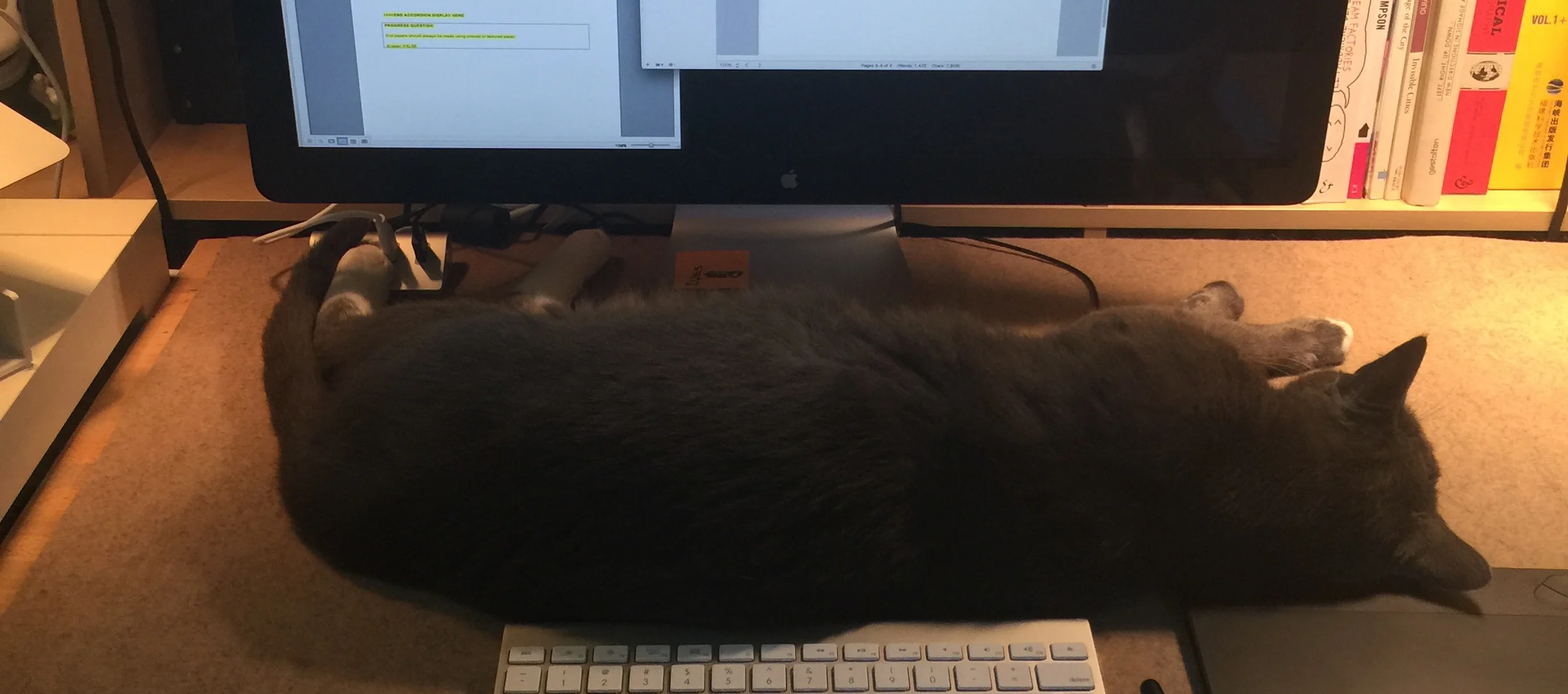
This meant I had at least three major projects due by midnight pacific standard time—3am at my house—every Sunday night (Monday morning) for fifteen weeks at a time. Last minute changes were always needed, so I would be up late, working on my projects, well after the husband, son, and cats had all fallen asleep. Coffee was my only friend. And, though I knew my classmates were virtually there next to me, I never felt so alone as I did at the end of major projects, fighting frantically to meet the final deadlines, unsure of whether my ideas were as good as I thought they were, while the house creaked and settled in darkness all around me.
Contrast that with what my students at Miami were doing. Typically, our deadlines aligned, oddly enough. Which meant that while I was stressing over kerning and tracking my 96-page book design due to my instructor that night, my students were stressing over kerning and tracking their triptych poster series due to me the next day. While I was working alone, feeling as if I were the only person in existence, my students were prodding each other to stay awake, or acting as alarm clocks for those who simply didn’t have the energy left to move from their desks to the lounge chairs that littered our space. Did I accomplish more, without the distraction of my classmates around me? Probably. Did this space for focus improve my educational experience? No.
Had we not been separated by a very boring and treacherous 45-minute commute, I might have done better to work on my own projects at the “office,” alongside my students, asking them to wake me after a 20 minute nap so I could check that last chapter before turning in the work. Though, in reality, that would have opened me up to being on the clock as their teacher, rather than being part of the community as a co-student. But maybe not.
Had there been more tools for online camaraderie in place, I’m sure my educational experience would have improved. My classmates and I had iChat, which helped. It certainly gave us unmitigated access to our thesis advisors and online director. But we needed someone “there,” not someone “available.” And at the time, tools to help us be “there” were simply not developed enough.
We did try, though. We set up external critique blogs, where we could meet during the week and discuss our work using synchronous and asynchronous systems. But these tended to last only the first few weeks of each semester, after which point we’d lose ourselves in the glow of our late-night computer screens as we frantically aimed to meet the ever-present deadlines, Facebook on screen in the background to remind us that others really do exist out there, away from our computers.
I’m a firm believer that all-night FaceTime sessions, where my classmates and I simply knew the other was online, would have provided at least an improved learning experience for all of us. We could have looked up at our screens every few minutes, smiled, and known that we were not the only people awake at that moment. Now that internet access is faster and cheaper, this idea is a far easier one to accomplish. And maybe, somewhere out there, students are taking advantage of social media and connection tools to establish their own educational communities with classmates and cohorts.
The question is, what can universities do to encourage this type of interaction? Should, an LMS work as a real-time connection tool, providing sub-environments outside of the classroom but inside the firewall to help online students gain that sense of belonging each college student should feel, just as traditional student unions and libraries do for onsite students? Or should this community-establishment be left to the instructor, inside the online classroom, where it can be more tailored to meet the needs of each course rather than the overall needs of each student in the system?
As I said, I’m not the expert here. But these are the questions I hope to begin answering as I continue my own investigations into what online education and learner experience design can be.