

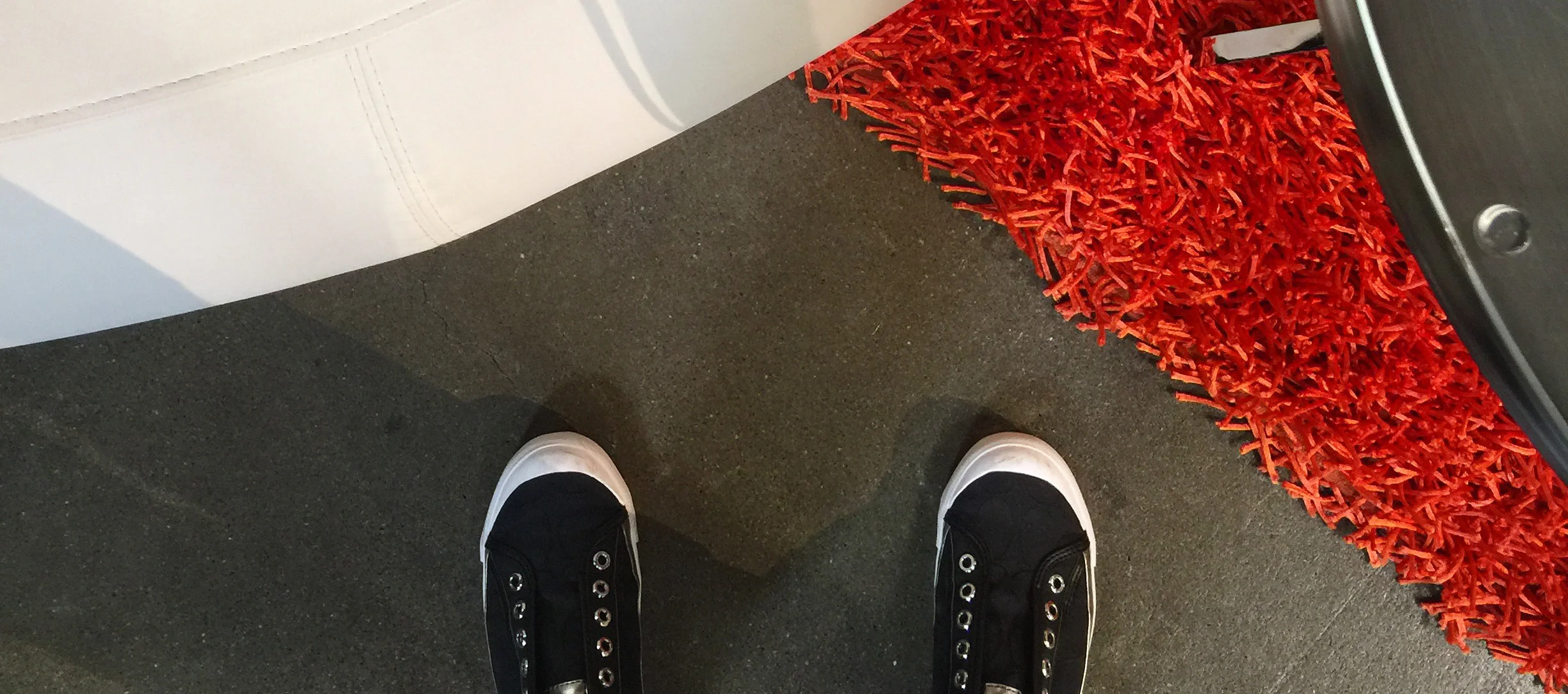
“The cobbler’s children have no shoes.” —Unknown
I’ve recently updated my personal website, which should not really be anything big in terms of news or major accomplishments. I’m a graphic designer, which sort of implies that I should always have an updated portfolio. In fact, because I’m a designer, one might say that I should obsess over my portfolio since this is sort of what I do for a living.
However, besides being a designer, I’m also an academician (which you might infer from my correct usage of the word “academician”). This means that keeping up a portfolio, much less a website of that portfolio, is a far greater challenge that it should be. And because of this, in academia, the portfolio website has a tendency to become a “cobbler’s child”—a design project we don’t have time to design because we’re so busy helping our students make their work look amazing.
Updating a vitae, making sure all student work is shown in its best light (both figuratively and literally), wordsmithing philosophy statements, verifying all teaching method statements actually make sense; and doing your best to look academically and professionally active takes a lot of work, which I found out when I started updating my site.
But beyond this, the point of putting in all of the effort needed to update the portfolio tends to be a means of to showing off what you can do in an effort to help you find the mythical "perfect job." Which means if you’re happy in your position, you ignore the website, usually—unless you’re someone like Helen Armstrong or Ellen Lupton, two great educators whose teaching lives outside of the classroom. In this case, these lovely ladies use their sites as a means of sharing their lessons more widely. Here, their sites become part of their work, and that means their information is always up to date and frequently changing. Unlike mine.
The thing is, when I started reworking my portfolio, it wasn’t to find another job. I actually really like my current position, since it lets me explore different ways of delivering meaningful academic content to students. My job lets me do something I love with a great group of people, and I get paid on top of that! So, no. I didn’t update my site to look for something “better.” I'm not fully convinced "better" exists.
But, of course, when I go to show my faculty team the updates (because all designers love praise from other designers), they don’t believe this—that I’m not looking for another job. They see the work, they notice that statements are solidified, that the cv is lengthy, and that I suddenly have a much more active social network than I did just last month. Naturally, they jump to the next logical conclusion. It’s sort of like your office colleague showing up in a suit and tie on casual Friday. You know he has an interview, no matter how insistently he claims he’s meeting his girlfriend’s parents after work.
The thing is, I’m really (really!) not looking.
So why did I spend all of that time and mental effort updating a site I don’t “need” to have up to date?
A portfolio website is more than a place to show off your work. I can become a running archive of your accomplishments, as well as a personal diary of the paths taken to complete them. And it’s this reason—remembering—that I did what I did.
I didn't (and don't continue to) update my portfolio site for personal satisfaction, self-glory, or even blatant self-promotion. I update the site so it will act as an accessible reminder that I actually enjoy what I do—help students understand what design is, what it can do, and why we need it, especially in today’s visually oversaturated environment.
But I also updated it to remember what I want to do. I used to be very active in the professional scene. I submitted to (and was awarded) design competitions. I went to conferences. I wrote papers. I had a research path and tested it in the classroom. I pushed myself to think beyond the daily checklist. And then I got a job that didn’t demand I do all of that anymore. So I stopped. And I forgot. Until I started updating my site.
In writing about my previous work, and looking through the amazing successes of my former students, I remembered why I went into academia, leaving a potentially lucrative design career in the wake. I remembered that I love sharing information with curious minds. And that I love helping people figure out why things work the way they do. I love the looks on their faces when that ah-HA! moment hits and they actually get it.
And I remembered that sharing the moments and methods of realization with other teachers, while they shared theirs with me, helped me learn how to be a better teacher. And that sparked the new social media activity. I’m looking to build a community of learning. And to do that, I need an up-to-date site.
At the same time, though, it is for glory… The portfolio.… I’ll admit it.
The purpose of a portfolio, after all, is self-promotion. It’s there to put your work out there so you can establish yourself as some form of expert at some level in some sort of field. Even here, where I’ve put evidence of my efforts in front of the world, I did so to set myself up as an academic expert. I can teach, and you can see this in the work of my students. I can design, and you can see this in the work I’ve completed. So, by putting this here, I’m trying to convince you—or maybe just myself—that I’m a "design education expert."
Or at least a "design education cobbler." With a lot more experience than I ever let myself admit. And a great portfolio of student work… Go look at it. It's wearing some awesome shoes. :)