

Last week, I posted something I’d written back in August, when I’d first started gathering content and coming up with ideas on how to position this blog. I was traveling for work at the time, which made writing new content a bit more challenging than it should have been. Working from my home office, with literally hours of time spent in glorious solitude, I find it easier to write than when I’m at the “mothership” (aka the campus) running around 12 hours each day.
So I slacked. I took the easy way out. I posted something I had never intended to post, just to get something online.
This week, I’ve been playing catch up, which also makes writing new content hard. So I’m going to post something I wrote, by hand, while on the plane heading towards that mothership. It might ramble. I’m not fully convinced it’s well structured. But it might give someone a sense of what it’s like to be an online educator. So, here goes.
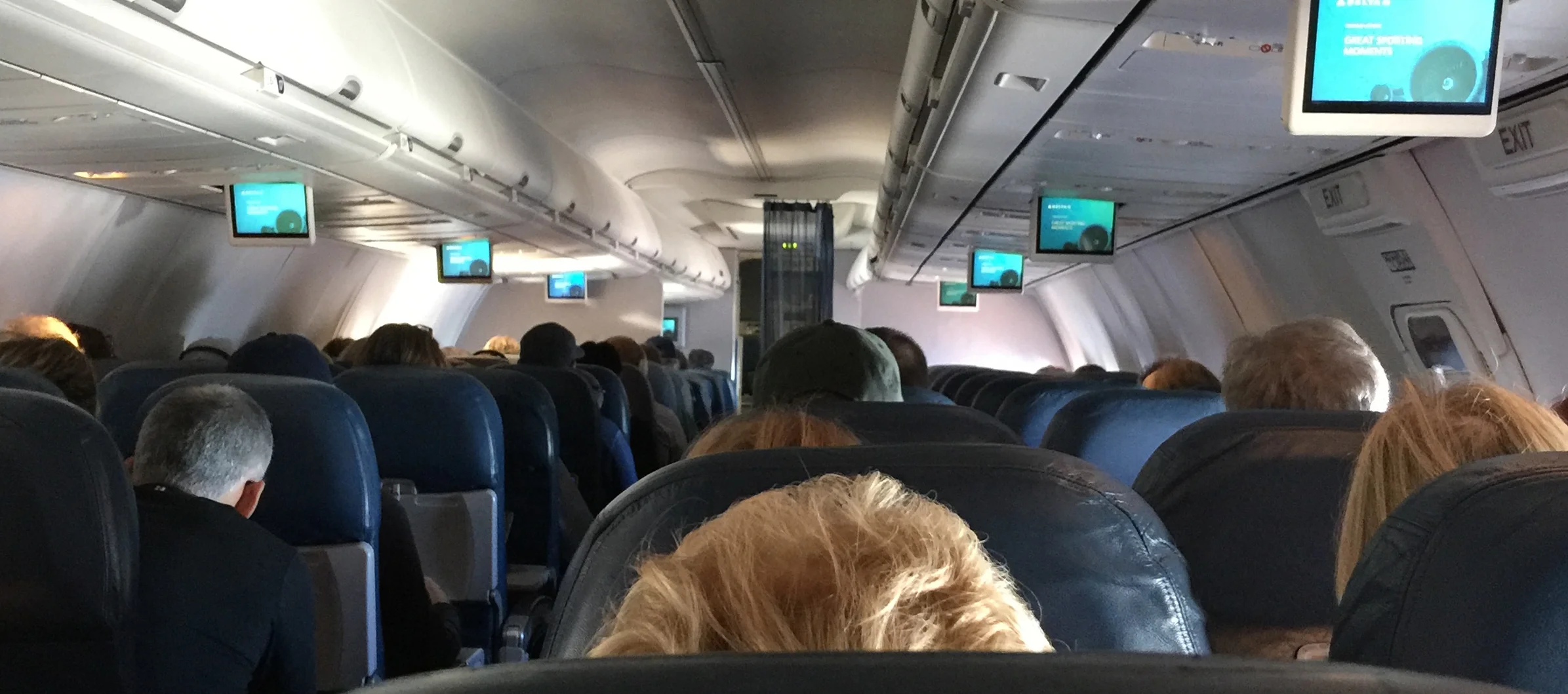
My view from the top.
At the moment, I’m on a plane. It’s Sunday, the weekend, and my family is at home, annoying or ignoring each other. And I’m on a plane.
It’s a relatively dark plane. For some reason, all passengers in my immediate area have closed their windows. Including the guy next to me. Who is in the wrong seat by his own admission. So, the only light within the cabin originates from multiple tiny overhead bulbs pointing in an awkward directions, including one that’s aimed right at my eyes.
Various conversations swirl around me, though I can only hear portions of each. Single voices within each group fight to drown out all others. And so I catch the occasional “You’re in the Midwest. We own the world!” comments, completely out of context, floating through the cabin, heard—but unchallenged—by all.
Eyes roll. Including mine. And I wonder how I find myself in this bizarre environment on a lovely Sunday while my family sits at home, annoying or ignoring each other.
The answer is “for work.” The answer is always “for work.”
The New Boss, Nothing Like the Old Boss
Full disclosure: I don’t always love my job. Like any job, there are aspects to it that drive me insane. The bureaucracy and decision-chain can be blindingly opaque, to the degree that groundbreaking ideas fall by the wayside simply because one or another upper level administrator is unsure of how to fold it into the existing academic model. But this happens in most, if not all academic settings. So as frustrating as it can be to abandon my obsessions, I do it because, for the most part, I actually love my job.
One of the reasons I love it is because I work with a number of fabulous teams, both in and out of my immediate department, who all loathe the perception of what online education is. See, in the olden days of two years ago, most online learning environments consisted of page after page of good- to mediocre- to poorly-written text aimed at conveying highly complex ideas. You might find images. You might even find low-resolution videos, but rarely was this extra nugget part of the package.
In many cases, this text (and image) content, coupled with a “work on your own” project, defined the entire online class structure. If you were lucky, or just did an appropriate amount of research to recognize the potential pitfalls, you’d end up in a class taught by a real-life teacher with ideas, opinions, and a pulse. In these rare, and typically expensive instances, you gained the best of both worlds—the flexible schedule afforded by an online classroom, and the onsite advantage of lessons being placed into context by an expert. This was the model I earned my MFA under. This is the model I teach under today. But as I mentioned, it isn’t cheap. And it still contains flaws that need to be worked out.
Today, things are a bit different than they were in the olden days. Today, online education seeks to put a human face to the online lessons. Which is why, at the moment, I am on a plane.
Video Saved the Studio Star
While I waited to board that plane, my weekly LinkedIn email hit my inbox. Oddly well timed, this week’s lead topic was about the use of social media videos as a teaching tool. The article opened by asking when companies should invest in short video formats as a means of deploying in-house training content. After all, their employees are already used to consuming this type of media within their social media network feeds. So what, exactly, are they waiting for?
The question is oddly in line with a similar idea I had in 2009, when I investigated the use of social media networks as vehicles of teaching in a traditional (aka brick-and-mortar) classroom. And it falls directly in line with the work I do today, writing and generating content of online graphic design courses.
About 18 months ago, after 20 months of playing the academic wallflower, hiding behind written class content in my online classroom, I found myself writing a course that could not live in a text- and image-only structure. Students in the existing course were having difficulties understanding assignments, and after rewording the same text over and over to no effect, I gave in. It would be easier to show how this was done than to tell them.
So I put in a request for a video shoot.
At that time, to remain consistent and “on brand,” I was told that all live demonstration videos were to be filmed in what the faculty had loathingly nicknamed “the black box”—a poorly lit sound studio lined with black velvet curtains. And because we were to film in a black room, I was additionally informed that I could not wear black (too little contrast), grey (too hard to color correct), or white (too much contrast) clothing. I was floored.
Let me explain. Aside from the clear educational concerns in the above mandates, I’m a designer. My entire wardrobe consists of black, gray, and white clothes, plus two or three awesome pairs of jeans—also not allowed per the university dress code.
I was tempted to show up naked. Instead, I picked a fight.
I argued that isolating the lessons inside of this environment (1) removed design from its professional environment, (2) bored the students as observed in my own previous experiences as an online student, and (3) ran the risk of making the students feel more isolated, seeing as they were watching the lessons happen in a literal void. I talked about how filming lessons in a faculty member’s office would provide a better sense of belonging than filming in a black box. It might even help students feel like they’re part of the actual campus community. I argued that the students were already consuming poorly-made videos on YouTube, and how our tuition-based content needed to feel more “produced” than this free offering. And I argued that many MOOCs and other (less expensive) online schools were presenting their materials in warmer, more natural environments, meaning our competition was already outpacing us.
This last one hit a nerve. I was given free-reign to shoot wherever I wanted to.
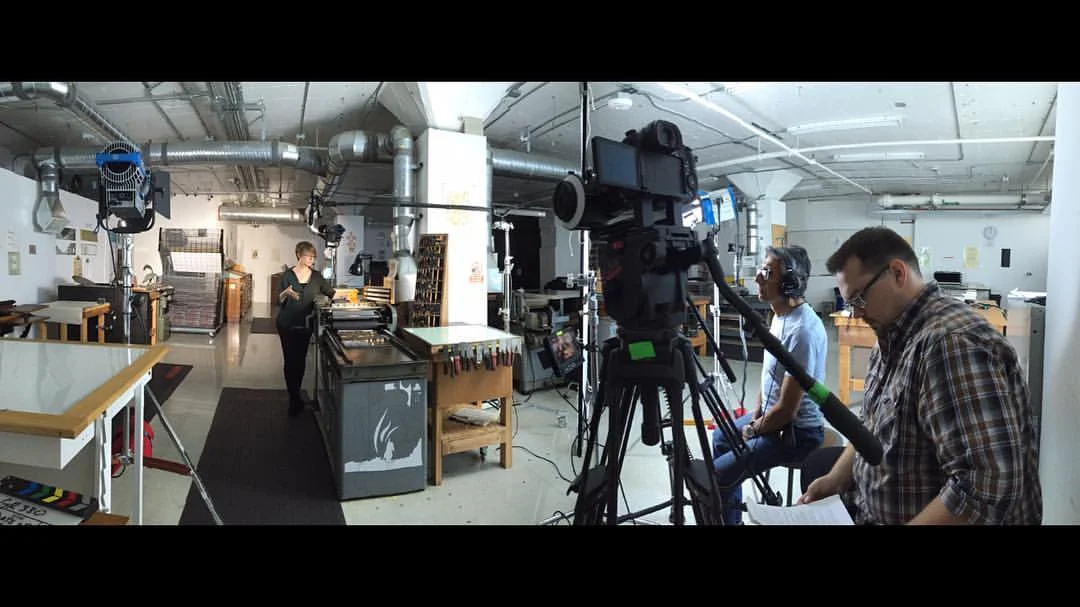
I wrote scripts for the videos I wanted to see when I was a student. I flew out to the city. And I took the video production team outside. They followed me all around the city as I pointed at different things and said “see? Cool!” while wearing black pants with gray and white shirts. They even came up with fantastic ideas on how to make these videos better, scouting new locations and finding more visually interesting backgrounds for me to work against. And now, they let me make a complete fool of myself by letting me "help" them from behind the camera. (I'm the one holding the clapper.)
Now, working out video lecture content is my favorite part of the job. And while the students still complain about the class, those complaints have shifted to how much work we expect them to do, instead of how little help they feel we're providing them.
We’ve made these types of videos for three graphic design classes now. And I’m proud to announce that the black box has been (for the most part) dismantled. Instead, faculty and video production are following our lead, letting lessons happen in the studio or any other environment in which learning feels natural. It takes a lot of time and a lot more coordination to get each project done. And each education team pushes itself with each iteration, trying to find better, more engaging ways of presenting lessons. But this model has opened a new competitive streak in the faculty—who can develop the coolest video yet?!? How can we present better and better ways of learning?!? What can we do to help the students feel more engaged?!? So we’ve at least made changes.
Each time I get on a plane headed toward the mothership for one more scheduled shoot, the academic wallflower in me cringes just a tiny bit less than it did the last time. Because our results noticeably help the students. Which is why we’re all here, after all.
So. It’s Sunday, the weekend, and my family is at home, annoying or ignoring each other. I’d rather be with them. But tomorrow’s online teaching challenge will be to look like I know what I’m talking about so my students will feel just a tiny bit less isolated as they watch my lectures at three in the morning on their laptop computers, coffee in hand while their families sleep in the next room.
For them, and only for them, at the moment, I am on a plane.